In Part 1 of our webinar recap, we focused on the foundations: how Air France–KLM built a cloud-based automation environment to enable Agentic AI at scale.
In Part 2, we are moving to a high-value use case: together with MOL Group we've showcased a working Agentic AI recruitment agent built on UiPath’s Agentic Orchestration stack.
This was not a concept sketch. It was a live proof-of-concept (PoC) designed to improve recruitment decision-making with AI – while keeping human oversight, privacy, and accountability at the center.
Why recruitment is a strong candidate for Agentic AI
Recruitment is inherently nuanced. It is full of ambiguity, exceptions, interpretation, and judgment.
Traditional RPA excels at clearly defined, rule-based tasks – but it struggles when the work involves:
-
interpreting CVs and complex job descriptions,
-
dealing with incomplete or inconsistent information,
-
applying context-dependent criteria across many candidates.
This is where Agentic AI shines. It can analyze unstructured inputs, apply rules in a flexible way, decide when human intervention is needed, and route tasks intelligently across people and systems.
The result is an assisted workflow that is faster, more consistent, and significantly more scalable than manual review alone.
Designing the recruitment PoC
 The recruitment use case was presented by Attila Németh from MOL Group and Tibor Glázer from BCA
 . They designed and implemented a PoC around a very practical question:
How can Agentic AI support recruiters and hiring managers in making better, faster decisions – without losing human control over the process?
The PoC was built using UiPath’s Agentic Orchestration stack, combining:
-
UiPath Agent Builder for the agents themselves,
-
Action Center for Human-in-the-Loop steps,
-
UiPath Maestro for orchestration, visibility, and auditability,
-
built-in tools such as the Calculator and dynamic placeholders (e.g. current date) for consistent evaluations.
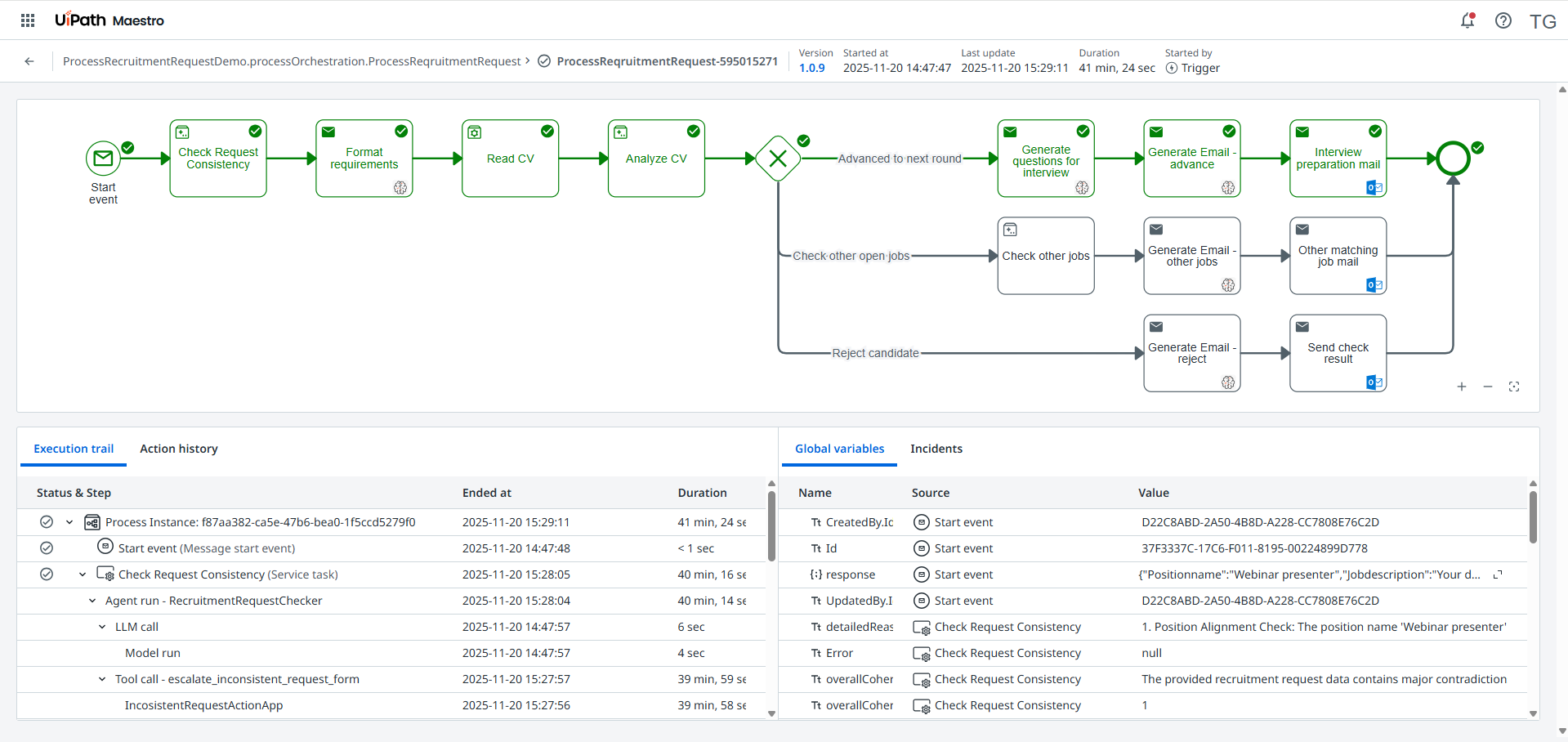
During the webinar, Tibor walked the audience through the end-to-end process:
-
Step 1 – A recruitment request enters the system
The process starts when a business colleague submits a simple form describing the position they are hiring for.
At this stage, the information may be incomplete, inconsistent, or written in very different styles – exactly the kind of variability that makes purely rule-based automation difficult.
-
Step 2 – Agent 1: The Consistency Checker
The first agent, built in UiPath Agent Builder, acts as a Consistency Checker. Its role is to evaluate whether the request:
-
is complete,
-
is logically consistent,
-
is free of contradictions or obvious gaps.
If something looks off, the agent automatically triggers a Human-in-the-Loop escalation, creating a task in Action Center where HR can review and refine the input.
Not everyone writes a perfect prompt or a well-structured scoring rubric. Using metaprompting, this agent converts high-level guidance from HR into a clear, optimized scoring system – ensuring that candidates are evaluated consistently from the very first step.
-
Step 3 – Candidate CVs are parsed
Once the recruitment request has been validated and refined, and candidate CVs are available, the central evaluation flow takes over.
The CVs are parsed and normalized so they can be compared against the defined criteria in a structured way.
-
Step 4 – Agent 2: The CV Analyzer
The second agent – the CV Analyzer – is responsible for evaluating each candidate. Using dynamic placeholders (such as the current date) and the built-in Calculator tool, it:
-
assesses experience and tenure,
-
interprets competencies and skills,
-
applies a consistent scoring logic across all candidates.
Based on the evaluation, the agent decides between three possible outcomes:
-
Advance to interview
-
Flag for re-review (a second chance with human input)
-
Generate a polite rejection
For candidates who advance, the agent also prepares:
-
tailored interview questions, and
-
personalized email content to support recruiters and hiring managers.
All of this is orchestrated through UiPath Maestro, making the workflow visible, traceable, and fully auditable end-to-end.
What this prototype demonstrates
The recruitment PoC highlighted several important aspects of Agentic AI in practice:
It enhances human decision-making.
Agents handle the repetitive, complex evaluation work, while humans stay in control of key decisions and exceptions.
It manages complexity that traditional RPA cannot.
The agents work with unstructured text, ambiguity, and nuanced criteria that are hard to capture in static rules alone.
It scales HR capacity without sacrificing quality.
Recruiters can focus on interviews, stakeholder alignment, and candidate experience instead of spending hours on manual pre-screening.
Attila and Tibor showed how a well-designed agentic workflow can blend automation, intelligence, and human collaboration into a seamless recruitment process.
Key takeaway – and what comes next
Agentic AI is ready for real, business-critical use cases – starting with areas like recruitment, where volume is high and human judgment is essential.
With the right environment (as seen in Part 1 with AFKL), the right tools (such as UiPath’s Agentic Orchestration stack), and a human-centric design, organizations can begin experimenting safely and incrementally.
Those who start now will define how AI-supported recruitment – and eventually many other processes – will work in the future.
If any of the topics discussed above are on your radar, or if there’s anything new you’re exploring about Agentic AI (or automation in general) that you'd like to have a chat about - then contact us!
--
Want to watch the full webinar? Email us at hello@bca.hu and we’ll send you the recording.