When thousands of items need processing within a short period, financial operations teams face a capacity challenge. Robotic Process Automation (RPA) can help them scale with the workload while maintaining accuracy and control.
This case study explores how a team handled more than 17,000 items without temporary staff - and where AI could add value.
The Challenge: When Workload Outgrows Available Capacity
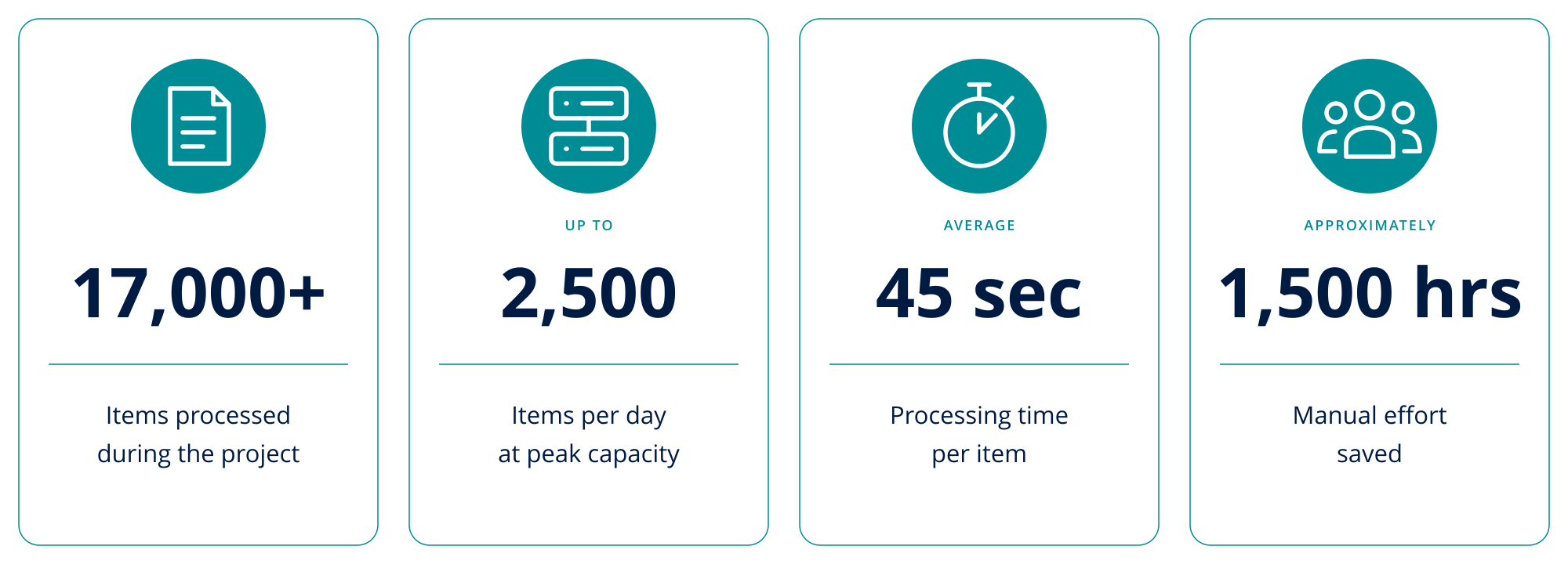
In a financial services workflow, more than 17,000 items needed to be processed during a concentrated period, with daily volumes reaching thousands at peak demand.
Each item required validation, multiple business decisions, and updates to an enterprise application. At 3–8 minutes per item, manual processing would have required additional temporary staff. Every case also needed accurate, consistent handling and a clear audit trail.
The central question was how to increase processing capacity while keeping the workload under control.
The Solution: Parallel Processing with Clear Exception Handling
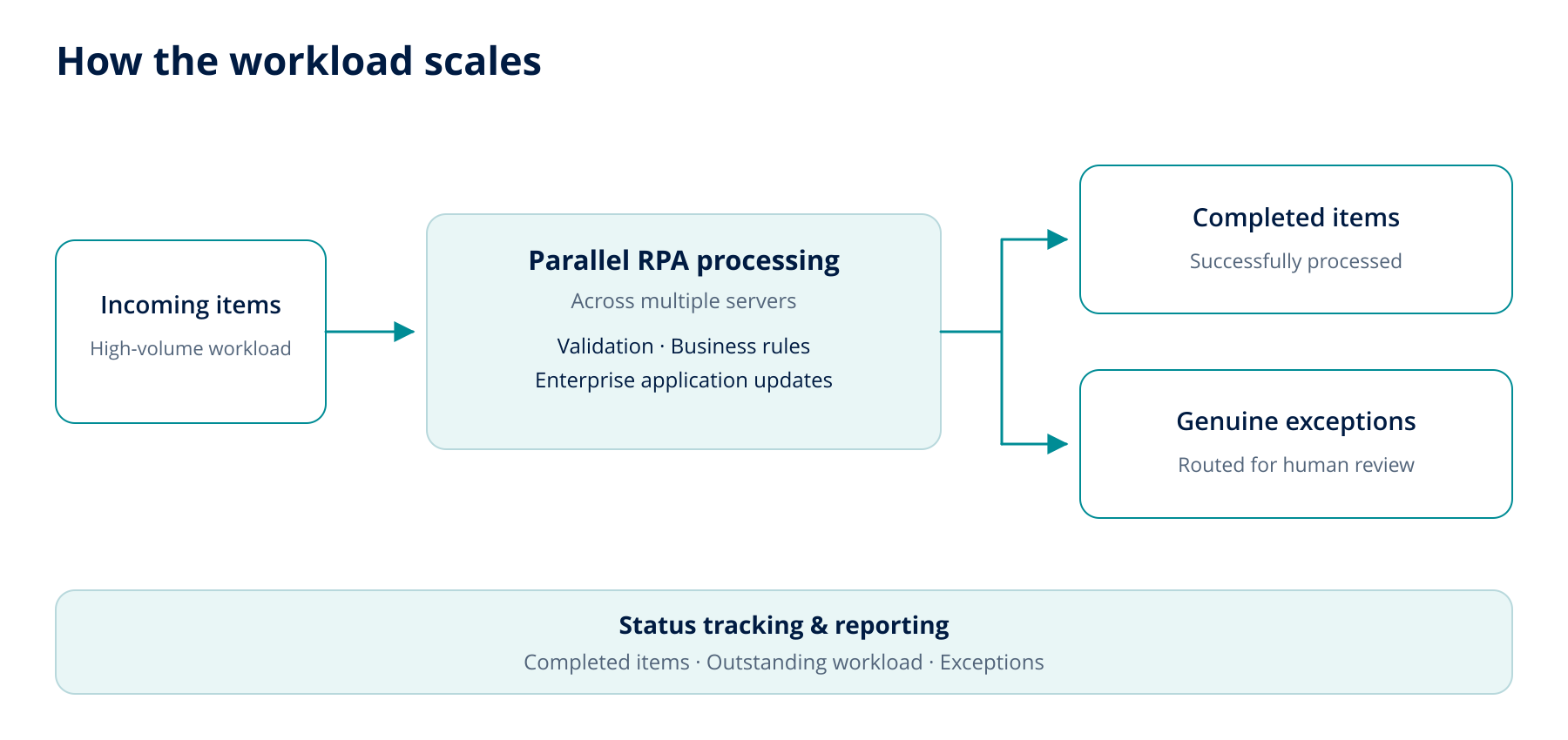
An RPA solution was developed to handle the workflow end to end, combining automated validation, complex decision logic, and structured exception handling.
To support peak demand, the automation was designed to run in parallel across multiple servers. This enabled the solution to handle up to 2,500 items per day, with an average processing time of 45 seconds per item.
Managing that volume also required a clear distinction between cases the automation could resolve and those that genuinely needed human attention. The solution assessed unusual situations using predefined business rules and routed genuine exceptions for manual review.
Detailed status tracking and reporting gave business teams visibility into completed items, outstanding workload, and exceptions. This supported operational control and resource planning throughout the processing period.
The Impact: Handling Peak Workload Without Temporary Staff
The automation successfully processed more than 17,000 items, eliminating the need to hire temporary staff and saving approximately 1,500 hours of manual effort.
Processing time per item fell by approximately 75–90%. Combined with parallel execution, this allowed the operation to handle concentrated demand with less reliance on manual capacity.
Consistent execution, comprehensive audit trails, and clear processing status helped teams monitor progress, while human involvement was limited to exceptions requiring attention.
The business value came from combining faster processing with the capacity to handle peak volumes and the visibility needed to oversee the work.
If We Built It Today: Where Would AI Agents Fit?
The decision logic would stay with RPA. In a regulated environment, clearly defined rules that must be applied consistently and leave a clear audit trail remain a strong fit for rule-based automation.
We would add AI around that core. A document-understanding model could read and check incoming PDFs, including poor-quality or non-standard documents, before passing the extracted data to the robot.
For genuine exceptions, an AI agent could prepare the case for the reviewer: summarise the issue, suggest a next step, and explain the reasoning. This would help people focus on making decisions with less time spent investigating each case.
An AI layer could also produce plain-language daily status reports and flag unusual patterns in volumes or exceptions early, further supporting resource planning.
The Key Takeaway
In high-volume, regulated environments, automation is about more than processing individual items faster. It is about building scalable, transparent, and resilient operations that can handle exceptional demand without compromising control or quality.
In this workflow, RPA provides the rule-based core, where consistency and auditability are essential. AI could support document interpretation and exception review, helping people make decisions faster.
Choose the simplest technology that solves each part of the problem well.