At scale, even a few minutes of manual work per invoice quickly adds up. Here’s what changed when RPA took over the repetitive part of the process.
For finance leaders, invoice processing is a familiar bottleneck: high volume, low margin for error, and a workload that grows every quarter without adding much strategic value on its own. Its high volume and rule-based nature make it a strong candidate for Robotic Process Automation (RPA) and this case study shows what that looks like in practice, inside a live SAP environment.
THE BUSINESS CHALLENGE: manually categorizing and booking incoming invoices was slow, repetitive, and error-prone - tying up skilled finance staff in low-value data entry.
The Cost of Doing It Manually
Before automation, booking a single invoice in SAP took a finance employee roughly five minutes - reading the document, identifying the correct cost center and GL account, checking it against internal policy, and keying it in by hand. On its own, that's a minor task. Multiplied across thousands of invoices a month, it becomes a significant, recurring drain on skilled employee time.
And time wasn't the only cost. Manual entry inevitably introduces small errors - a wrong cost center, a mistyped amount, a misclassified invoice type. Individually minor, but collectively expensive: they lead to reconciliation work, reporting inaccuracies, and delayed payments.
The RPA Solution
The organization deployed a software robot to handle the invoice-to-booking process end-to-end inside SAP. The robot reads incoming invoices, extracts the relevant data (vendor, amount, VAT, cost center, GL account), validates it against pre-defined business rules, and posts the entry directly - with no manual re-typing required for the majority of cases.
This isn't automation for its own sake. It's a deliberate reallocation of effort: the robot absorbs the predictable, rules-based volume, while employees are reserved for the decisions that genuinely require human judgment.

The Business Impact
-
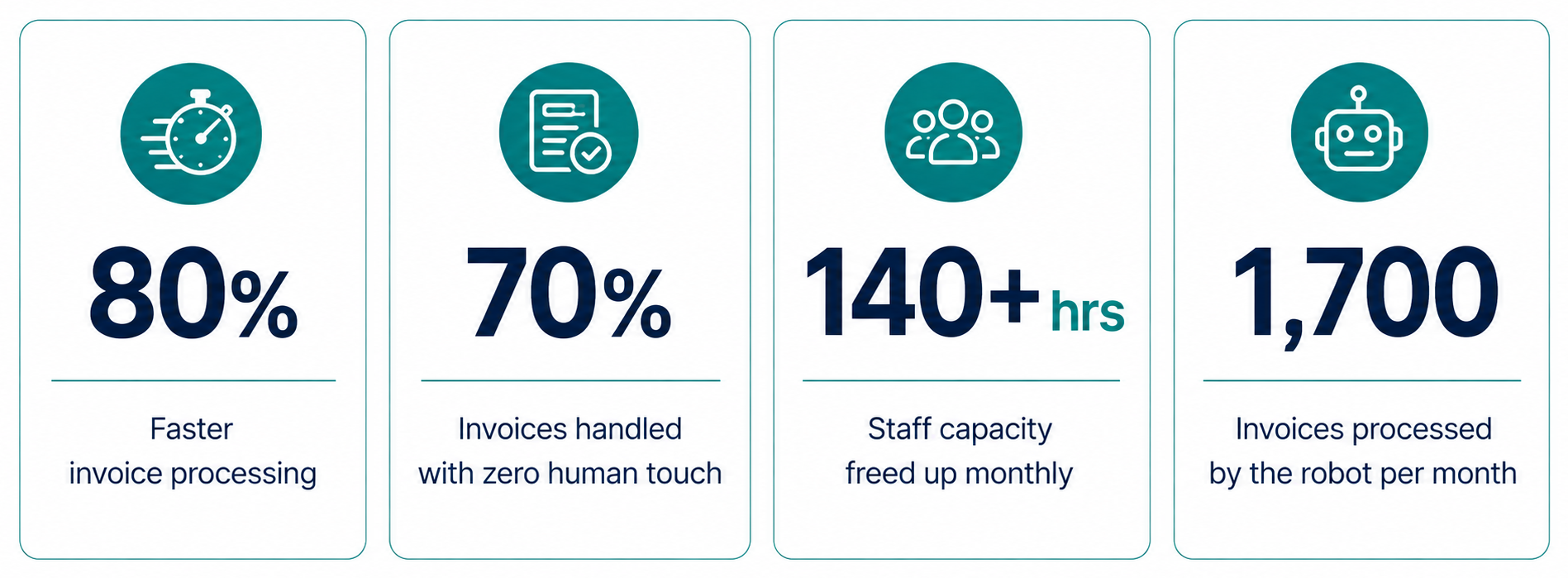
80% reduction in processing time - average handling time dropped from 5 minutes to about 1 minute per invoice.
-
140+ hours of employee capacity recovered every month - time that can be redirected toward higher-value analysis and decision-making instead of data entry.
-
1,700 invoices processed by the robot per month - allowing the process to scale with volume without a proportional increase in manual workload.
-
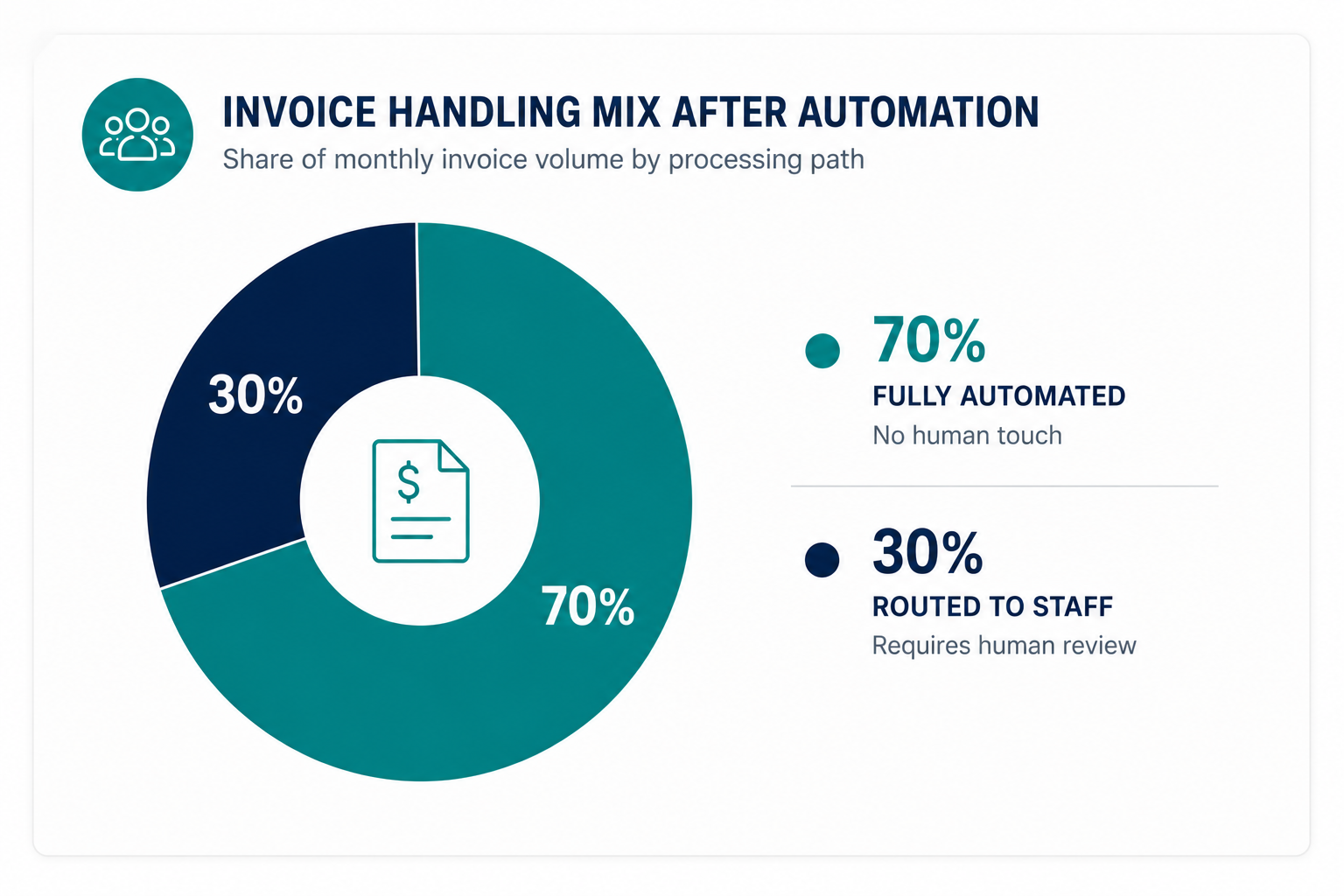
Over 70% straight-through processing - the majority of invoices now move from receipt to final SAP posting with zero human involvement.
-
Fewer booking errors - thanks to consistent rule-based validation.
Why the Remaining 30% Still Needs a Human Touch
A mature automation strategy isn't about chasing 100% - it's about automating what should be automated and routing the rest intelligently. Roughly 30% of invoices in this case still require staff review, for a few well-understood reasons:
-
Special exceptions: Invoices that fall outside standard categorization logic and require a judgment call.
-
Low-volume formats: Rare vendors or layouts the robot hasn't seen often enough to process with full confidence.
-
Poorly structured or low-quality documents: Inconsistent layouts, blurry or skewed scans, and other document-quality issues can make automated field mapping unreliable.
Rather than force the robot to guess, these cases are automatically routed to the finance team - protecting data accuracy while still maximizing what gets automated. This is precisely the kind of hybrid model that delivers the best return: robots handle scale, people handle nuance.
What's Next: Phase 2 on the Horizon
The natural next step is that ~30% that still goes down the manual path. Here, an LLM would read and interpret the invoices, suggest the classification - cost center, GL account, invoice type - and prepare the posting. On the hard cases, the employee wouldn’t start from scratch: they’d get a ready draft to approve or correct.
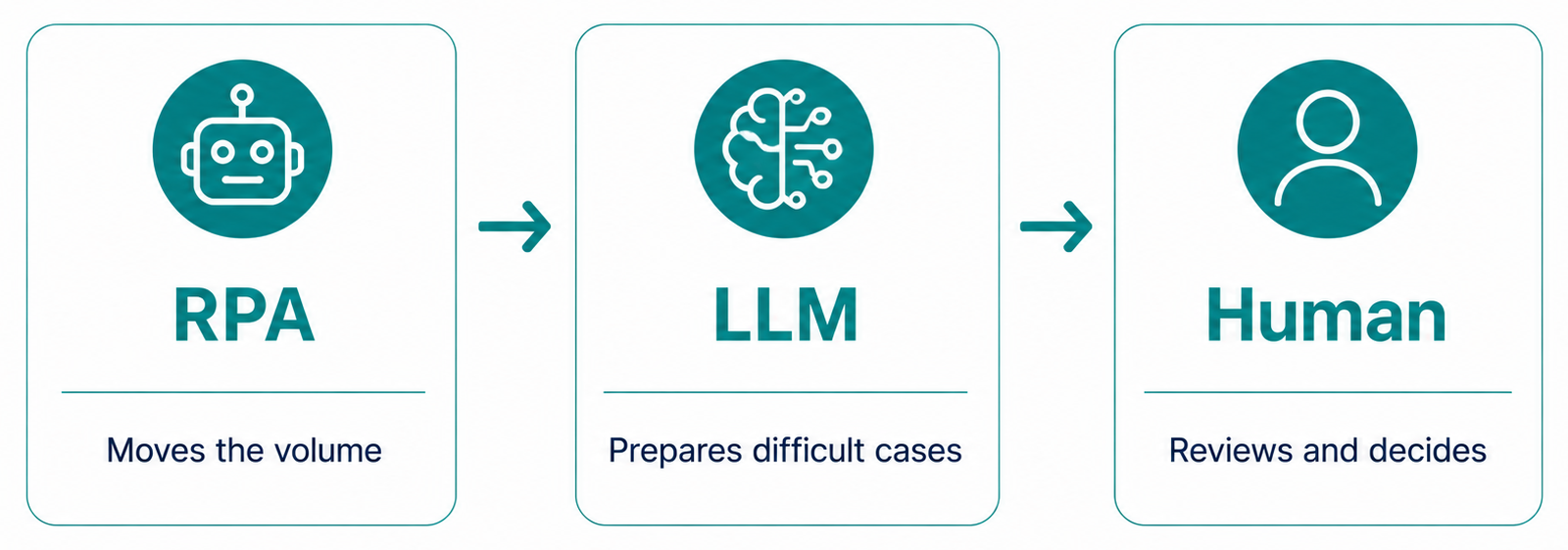
The aim is to push straight-through rates even higher and cut manual work where rule-based RPA alone can’t cope. On cases that are hard to codify but easy to judge at a glance, the LLM would sit between robot and human: the robot moves the volume, the LLM prepares the difficult cases, and the person decides faster with less repeat work.