In a finance operations environment, reporting on new securities issuances was a fully manual process, carried out step by step by employees. What seemed like a routine task actually involved processing around 1,500 transactions each year.
Each item took about 10 minutes to complete manually, adding up to more than 250 hours of work annually. Collecting documents, preparing file packages, and sending them to the right stakeholders all depended on human effort, increasing the risk of missing attachments, incorrect recipients, and inconsistent file handling.
By automating this administrative workload, the team was able not only to make the process faster, more reliable, and easier to scale, but also to free up capacity for higher-value work requiring more attention, judgment, and business focus.
The Objective
From Manual Administration to a Fully Automated, Scalable Process
The goal of the initiative was not simply to speed up one operational task. It was to design a process that was fully automated, auditable, reliable, and scalable, while reducing administrative effort and improving consistency.
To achieve this, an unattended UiPath robot was implemented. Operating without human intervention, the robot now performs the full end-to-end workflow:
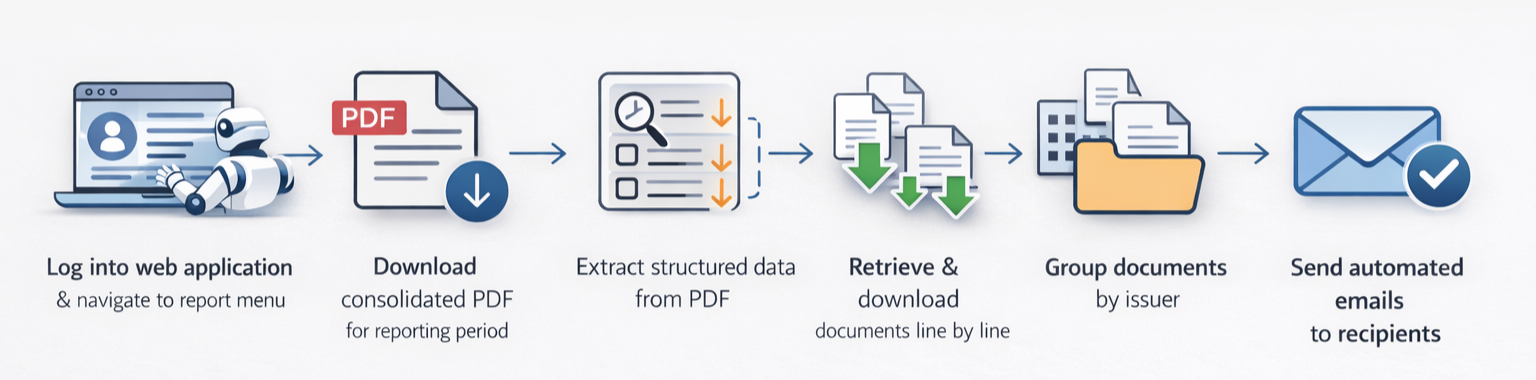
On an annual basis, this means the automated handling of approximately 1,500 individual PDF documents, with no manual involvement required during day-to-day execution.
What Made the Project Truly Interesting
The Real Complexity Came from the Environment, Not the Process Logic
What made this use case especially valuable was that the challenge did not primarily come from the business process itself. The real complexity came from the behaviour of the live production environment and the technical conditions under which the automation had to operate.
Among the key challenges were:
-
dynamically appearing and intermittently inactive web elements
-
asynchronous PDF generation, where the download button was not immediately available
-
incomplete or only partially generated data rows
-
non-unique primary identifiers
-
network instability and unpredictable system response times
These are the kinds of issues that often turn an apparently simple automation into a much more sophisticated engineering task.
To ensure stable and resilient operation, the solution required more than basic workflow automation. It relied on carefully designed waiting strategies, retry mechanisms, status monitoring, row-level exception handling, and file integrity checks.
Importantly, the robot does not rely on fixed delays. Instead, it monitors the actual state of the system and reacts accordingly. This makes the process significantly more robust: the automation does not fail simply because a page loads more slowly than expected or a button becomes active a few seconds later than usual.
Business Impact
Measured Efficiency Gains and Higher Process Reliability
The automation delivered clear and measurable business value, both in terms of time savings and operational quality.
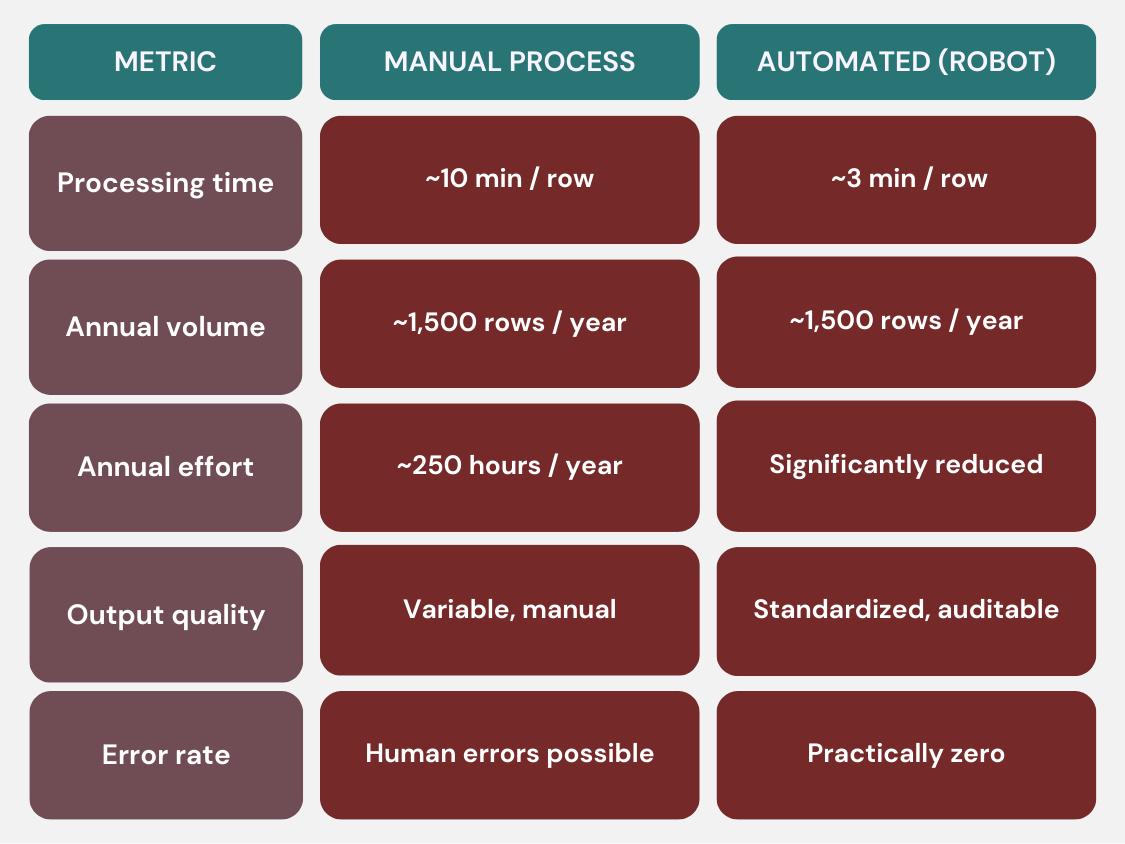
Overall, the solution resulted in more than 70% time savings, while also removing a considerable administrative burden from the operations team.
This created room for colleagues to focus on higher-value activities instead of repetitive manual work. At the same time, the process became far more predictable and easier to scale, meaning that future growth in transaction volume no longer translates directly into higher operational effort.
Key Takeaway
RPA Delivers More Than Time Savings
Perhaps the most important lesson from this case is that RPA is not only about saving time.
It also brings greater operational reliability, consistency, auditability, and predictability to processes where manual routine tasks once consumed significant energy and attention.
In this case, automation did not simply make an existing process faster. It made it stronger, safer, and more sustainable for the business.